⚽ Welcome to the Hub

Football Skill Matrix

The Football Skill Matrix is a multi-dimensional developmental framework designed to guide soccer academies, managers, and physical educators. By structuring training objectives across the three critical coaching pillars—Technical/Tactical skill, Physical Prep (S&C), and Psycho-Social growth—the matrix ensures age-appropriate loading and soccer mastery. This platform serves as a complete interactive roadmap, introducing developmental pathways to guide players smoothly from grassroots discovery all the way to competitive performance stages.

The 4 Developmental Phases:
U6 - U8

Discovery Phase

Focusing on individual play, ball exploration, and fundamental movement skills.

U9 - U12

Golden Age of Skill

Prioritizing technical ball mastery, motor coordination, and basic cooperation.

U13 - U15

Development Phase

Introducing team shapes, tactical spatial relations, and structured S&C loading.

U16+

Performance Phase

Targeting team tactical optimization, full S&C execution, and match performance.

The Three Coaching Pillars of Youth Football

Holistic soccer development rests on three foundational pillars. Balancing these key domains ensures that young players develop both athletic skill and mental resilience.

Technical & Tactical

Prioritizes ball mastery, first-touch efficiency, spatial awareness, and game intelligence. Players transition from individual skill discovery (U6-U8) to cooperative play formats and tactical problem-solving.

Physical Preparation (S&C)

Focuses on movement literacy, speed, agility, deceleration mechanics, and age-appropriate strength training. Building core motor skills and physical capacity reduces injury risks while maximizing dynamic performance.

Psycho-Social Growth

Cultivates peer communication, teamwork, resilience, sportsmanship, and mental focus. Building emotional maturity and confidence helps athletes deal with victory, defeat, and life off the pitch.

Physical Capacities in Youth Football

Explore the core physiological requirements of football. Click on any capacity box below to reveal its description.

🏋️

Strength

The ability of muscles to exert force against resistance. Crucial for explosive acceleration, ball shielding, and physical body contact.

Click to read description
🏃

Speed

The rate at which a player covers distance or executes movements. Key for short sprints, recovery runs, and winning 50-50 duels.

Click to read description
⚡

Agility and Coordination

The capacity to change directions rapidly under control, combined with the synchronization of complex motor movements. Enables evasive dribbling, ball tracking, and athletic body coordination.

Click to read description
🔋

Aerobic Fitness

The efficiency of delivering and using oxygen. Essential for sustaining stamina over a 90-minute game and recovering between sprints.

Click to read description
🔥

Anaerobic Fitness

The ability to perform explosive, short-duration activities without relying on oxygen. Drives repeated sprints, jumps, and shots.

Click to read description
🧘

Mobility and Flexibility

The passive and active range of motion across key joints (hips, knees, ankles). Enhances movement fluidity and prevents injuries.

Click to read description

The Skill Matrix Grid

Select any development cell to examine targeted coaching details. Click the buttons inside the details panel to view age-appropriate deep-dives and sessions.

Age Phase Technical / Tactical Physical Prep Psycho-Social
U6 - U8 Discovery Initiation & Play
Ball mastery, 1v1 dribbling, basic passing pushes.
View details
ABC's (Agility, Balance, Coordination), tag games.
View details
Fun, basic sharing, learning to follow rules.
View details
U9 - U12 Golden Age Foundation Skills
First touch, scanning, pass angles, 3v1 rondos.
View details
Running mechanics, acceleration, core balance.
View details
Collaboration, peer feedback, handling failures.
View details
U13 - U15 Development Tactical & Position
Weighted passes, group possession, position roles.
View details
Strength baseline, speed endurance, agility runs.
View details
Role accountability, resilience, team identity.
View details
U16 - U17+ Performance Competition Prep
Speed of play, structural shifts, game management.
View details
Aerobic conditioning, strength conditioning, power.
View details
Leadership, stress management, hyper-focus.
View details
U6 - U8
Physical Prep

Core Target Focus

Focus on Agility, Balance, and Coordination (the ABC's) through multi-directional play and obstacle courses. Avoid structured cardiovascular conditioning and static weights.

Key Exercises / Drills

  • Tag games (Robbers & Cops, Tail Tag)
  • Coordination ladders (simple one-step patterns)
  • Obstacle courses (running, jumping, balancing)

Coaching Emphasis

Incorporated into warm-ups and fun intervals. 100% play-based movement exploration.

Strength & Conditioning

Explore how strength & conditioning evolves from younger to older ages, going from coordination and balance approaches towards agility and strength approaches.

Building the Football Athlete

Strength & Conditioning in youth football is not about heavy weightlifting. It is about building movement efficiency, motor skills, and tissue resilience. Proper S&C coaches a player how to land, stop, rotate, and accelerate safely, which drastically reduces injury risk (ACL, groin, joints) while maximizing athletic output.

As youth players transition through physical maturation, training must focus on matching biological age indicators, ensuring a smooth path from basic motor skills to competitive physical dominance.

Physical Development Indicators

  • U6-U8 ABC's & Movement Play
  • U9-U12 Speed Window & Deceleration
  • U13-U15 Core Base & FIFA 11+ Protocols
  • U16+ Power, Anaerobic capacity, Strength work
U6 - U8
Discovery Phase: Movement Exploration

Focus is entirely on fun games that stimulate the central nervous system. Training develops general motor patterns without rigid conditioning.

Focus Indicators:
  • Agility, Balance, Coordination (ABC's)
  • Dynamic stability (single-leg balances, crawling)
  • Multidirectional running (backwards, sideways shuffling)
U9 - U12
Foundation Phase: The Speed Window

Exploiting the biological window for rapid speed and nervous system coordination development. Focus is on footwork speed and landing mechanics.

Focus Indicators:
  • Deceleration mechanics (how to bend knees and absorb force)
  • Sprint acceleration mechanics and rapid change-of-direction
  • Bodyweight fundamental strength (squats, lunges, planks)
U13 - U15
Development Phase: Functional Strength & Base

Managing peak height velocity (growth spurts). Building dynamic core strength, aerobic endurance base, and rigorous injury prevention routines.

Focus Indicators:
  • FIFA 11+ injury prevention warm-ups
  • Dynamic core control and spinal alignment (posture)
  • Light resistance exercises focusing on strict technique

S&C Drills

Explore key strength and conditioning exercises focused on building agility, core strength, speed, and explosive power for athletes.

U13 - U17+
Agility T-Drill
Speed & Change of Direction
U13 - U17+
Single-Leg RDL
Core & Balance
U16+
Resisted Sprints
Acceleration Power
U16 - U17+
Depth Jump to Header
Plyometric Power

Agility T-Drill

Focus: Speed & Change of Direction
Grid: 10x10 Yards
Equipment: 4 Cones

Instructions

Player starts at cone A, sprints forward to cone B, side-shuffles left to cone C, side-shuffles right to cone D, shuffles back to center cone B, and backpedals to the start.

Coaching Points

  • Stay low during shuffles to maintain balance
  • Plant outside foot to change direction rapidly
  • Keep chest forward, do not cross feet while shuffling

Coaching Tactics Sandbox

Design your own training drills. Drag players, cones, and balls onto the pitch. Click the Pencil tool to draw running paths (solid lines with arrows) and ball/cone placements.

*Drag tokens onto the field to reposition. Switch to Draw Mode to sketch plays directly on the board. Double-click placed tokens to delete.

1. Sandbox Mode

2. Draw Settings

Line Color:

3. Spawn Equipment

R
Red Player
B
Blue Player
⚽
Football
Cone

4. Canvas Actions

Deep Dive: Plyometric Ability

A deep dive into U16/U17+ explosive power training. Browse through the drill catalogue to explore specific plyometric exercises.

Coach's Rationale: Why Plyometrics?

"As a Strength and Conditioning coach, I chose Plyometric Ability for this deep dive because it represents one of the most critical training modalities across all age groups—from youth development to senior elite sports. Extensive sports science research consistently proves that carefully programmed plyometrics significantly enhance neuromuscular coordination, explosive power, and injury resilience, making it an indispensable tool in modern athletic preparation."

Dynamic plyometric training

What are Plyometrics?

Plyometrics are explosive exercises that condition the neuromuscular system to generate maximum force in minimal time. By leveraging the Stretch-Shortening Cycle (SSC), these movements train muscles and tendons to store and rapidly release elastic energy like a coiled spring.

Why use them in youth football?

  • Explosive Speed: Decreases ground contact time, translating to faster first-step acceleration on the pitch.
  • Agility & Deceleration: Enhances the ability to absorb force rapidly, allowing for quicker changes of direction.
  • Injury Resilience: Increases tendon stiffness and structural integrity, drastically reducing the risk of ACL and joint injuries.

Plyometric Exercises Catalogue

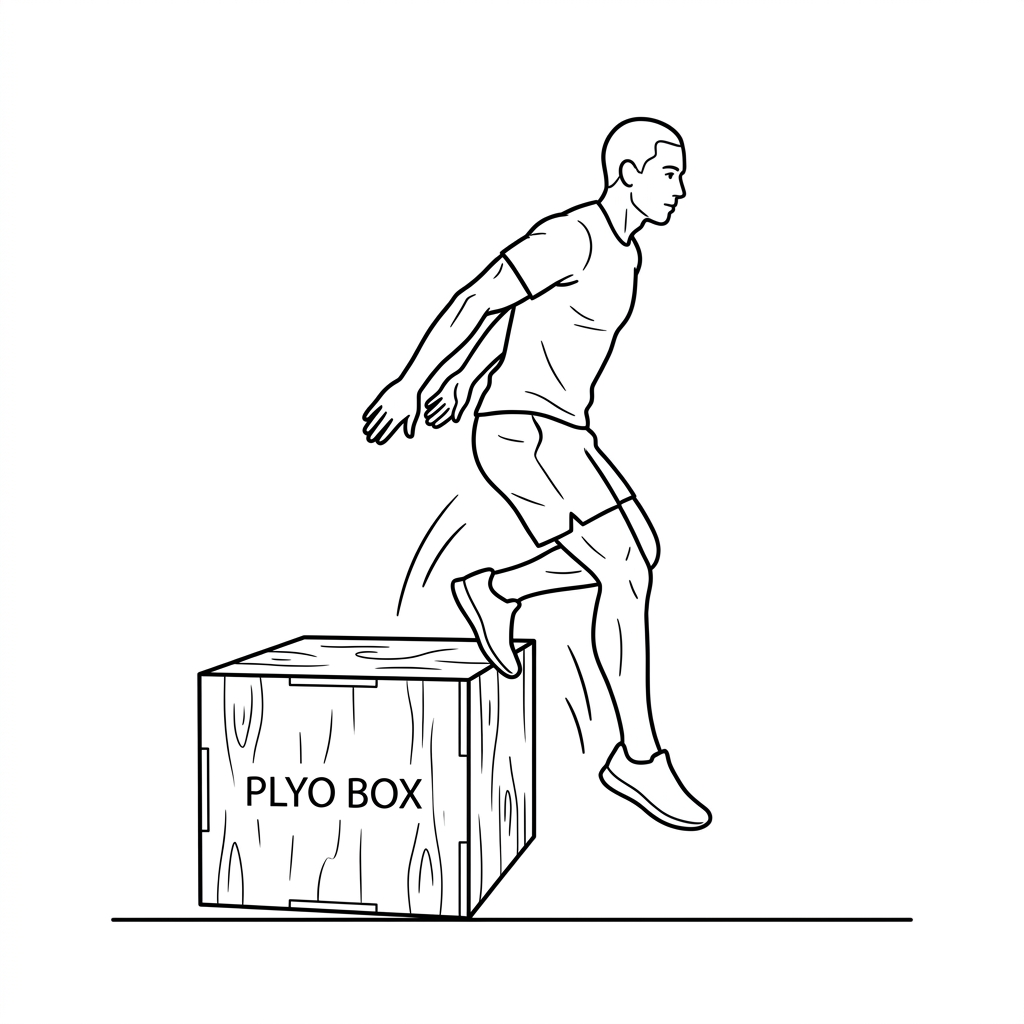
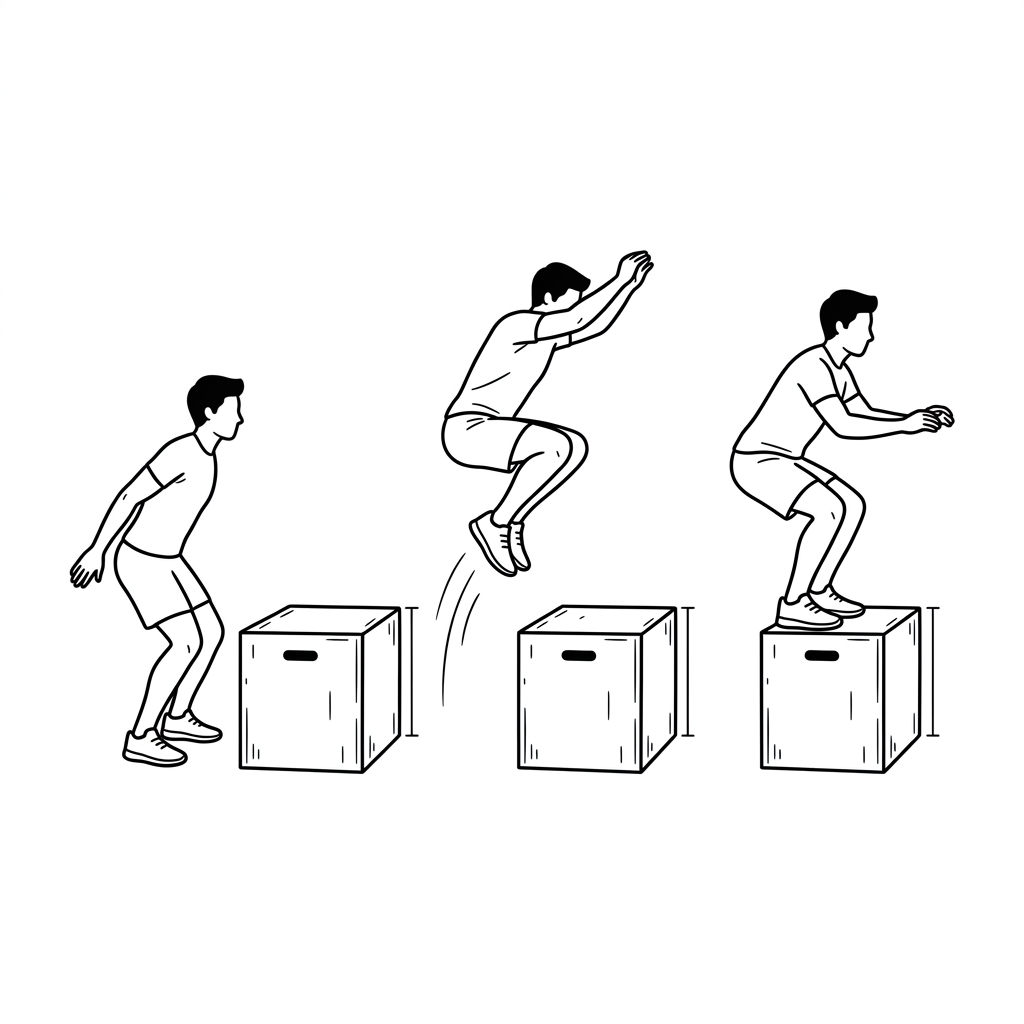
1. Box Jumps

Focus: Concentric Power Sets: 3-4 Reps: 4-6 Material: Plyometric Box
Box Jump Exercise

The Box Jump focuses purely on explosive concentric force production. By landing on an elevated surface, the eccentric (landing) forces are minimized, making it an excellent introductory power drill that spares the joints from high impact.

  • Stand shoulder-width apart.
  • Hinge hips and swing arms back.
  • Explode upward and forward onto the box.
  • Land softly in a quarter squat.

2. Drop Jumps

Focus: Reactive Strength (RSI) Sets: 3 Reps: 3-5 Material: Plyometric Box
Drop Jump Exercise

Drop Jumps target the fast stretch-shortening cycle (SSC). This is a highly advanced plyometric drill aimed at improving ground contact times and tendon stiffness, which directly transfers to sprinting and agility.

  • Step off a low box (30-40cm).
  • Anticipate the ground and stay rigid.
  • Upon contact, rebound vertically as fast as possible.
  • Minimize ground contact time (< 250ms).

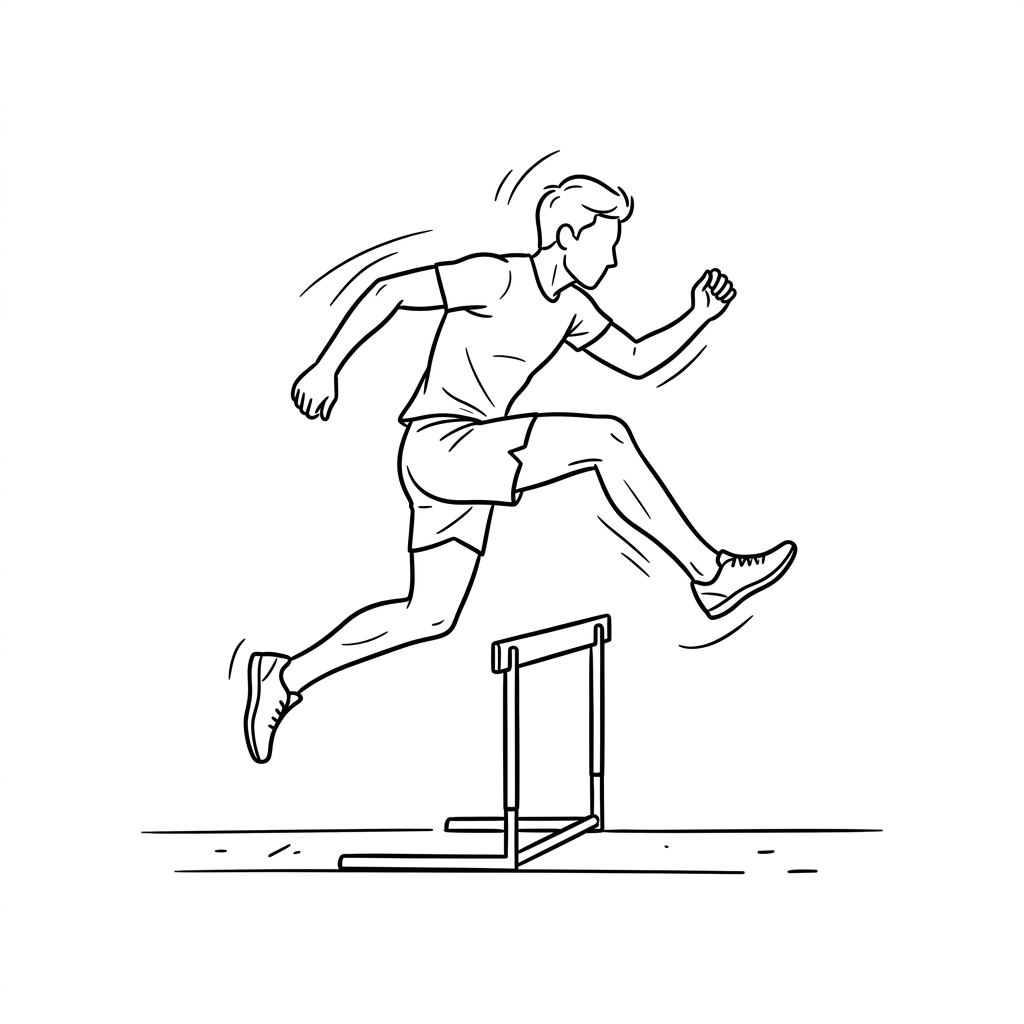
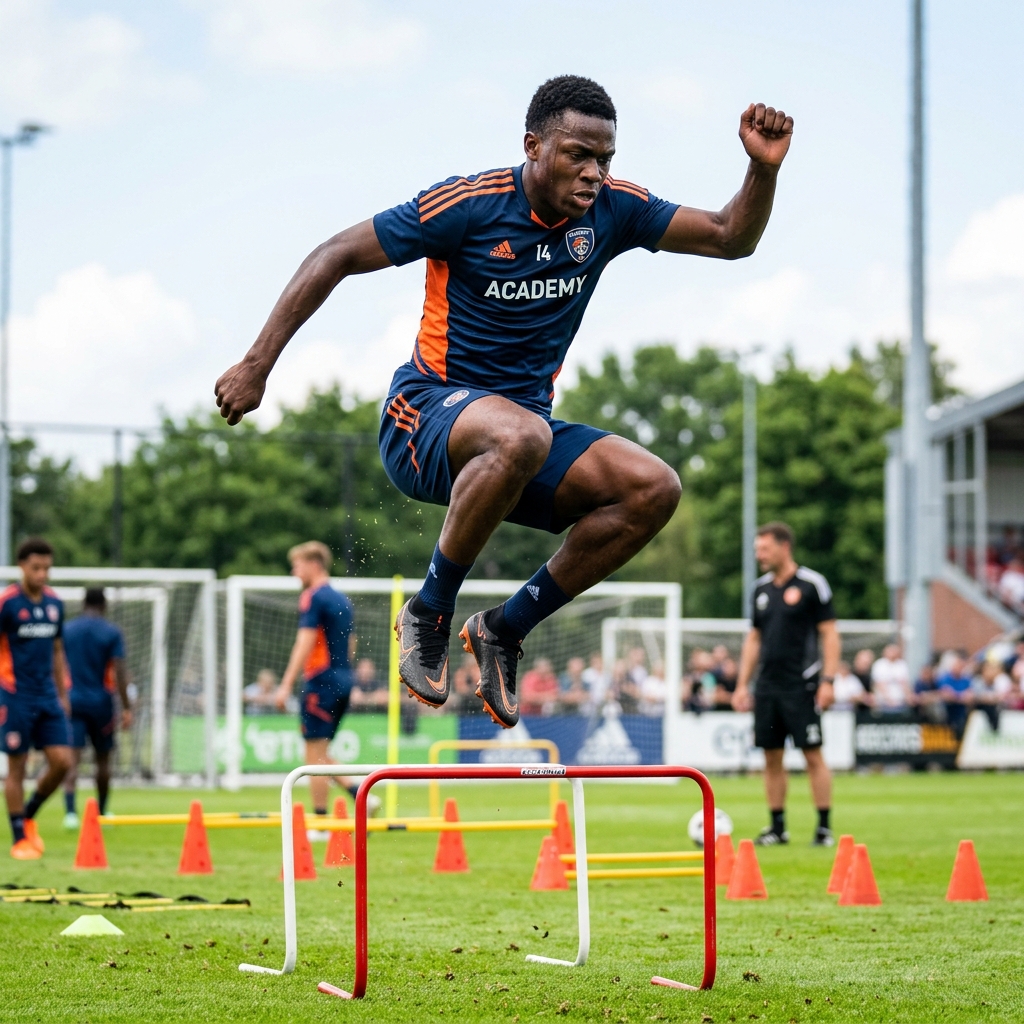
3. Continuous Hurdle Hops

Focus: Elasticity & Rhythm Sets: 3 Reps: 4-6 hurdles Material: Micro Hurdles
Continuous Hurdle Hops Exercise

Hurdle hops challenge the athlete to link multiple explosive actions together, testing their rhythm and ability to continually absorb and produce force rapidly.

  • Set up 4-6 hurdles evenly spaced.
  • Perform continuous double-leg hops over each.
  • Focus on a quick bounce with minimal knee bend on ground contact.

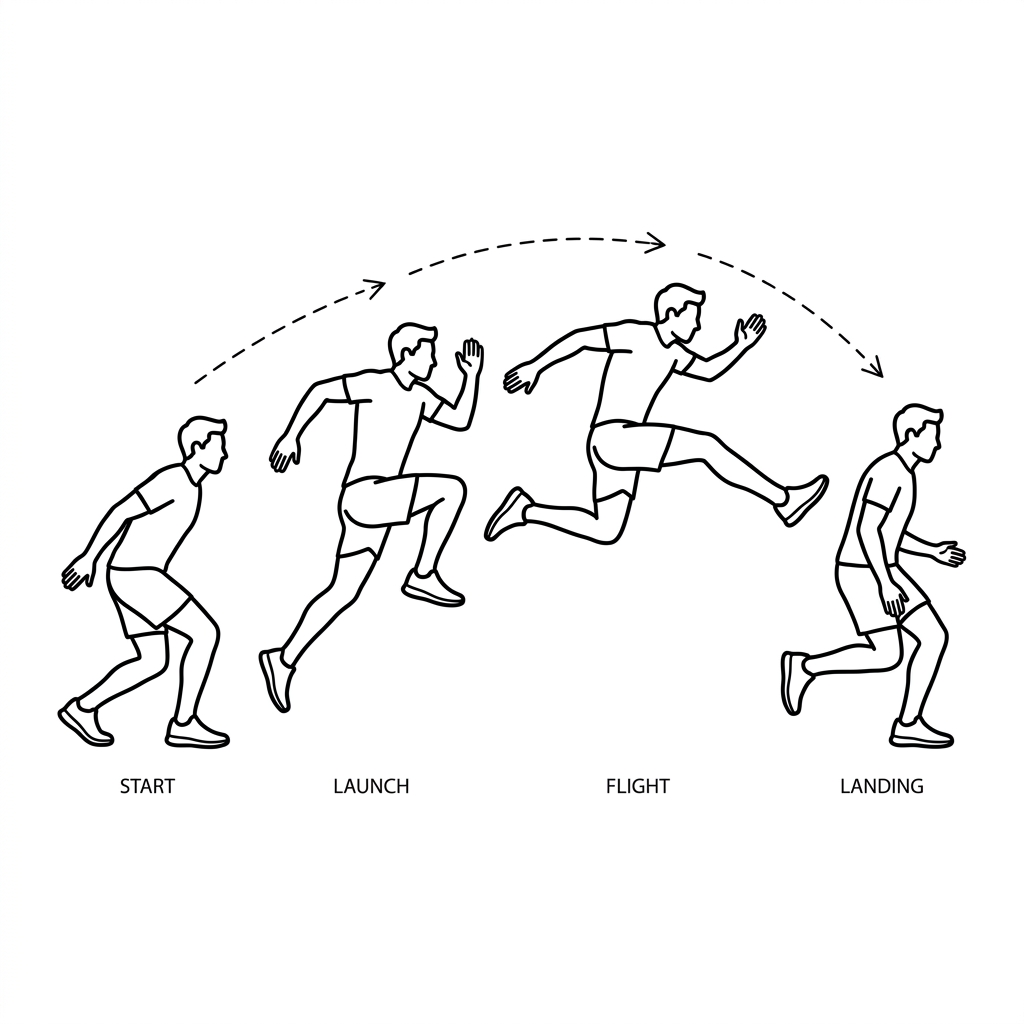
4. Unilateral Bounds

Focus: Single-Leg Power Sets: 3 Reps: 10-15m per leg Material: Field (Optional Cones)
Unilateral Bounds Exercise

Bounding develops horizontal power and single-leg stability. It forces the athlete to stabilize the hip and knee under high loads, transferring directly to sprinting speed and cutting.

  • Explode off one leg forward and upward.
  • Drive the opposite knee high (sprint mechanics).
  • Land on the opposite leg and immediately bound again.

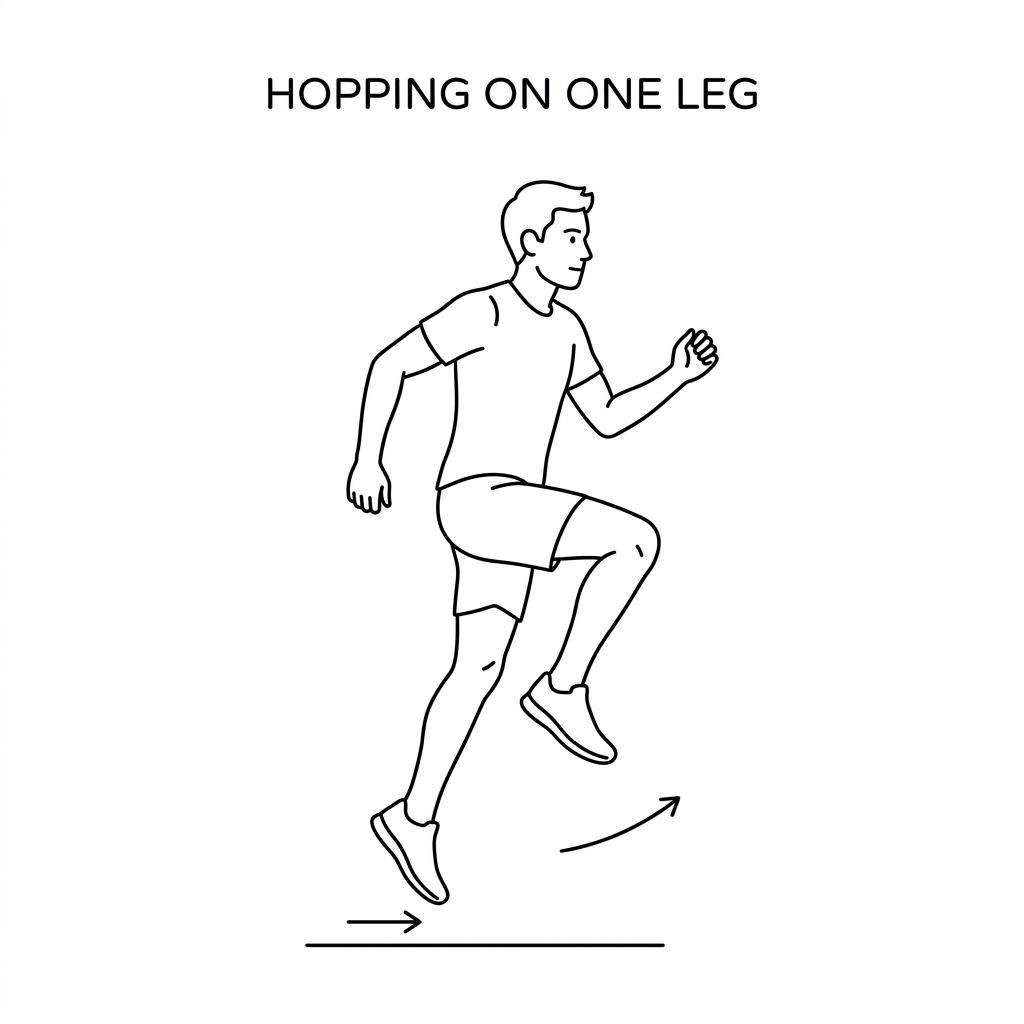
5. Unilateral Hops

Focus: Single-Leg Stiffness & Rhythm Sets: 3-4 Reps: 8-10 per leg Material: Field
Unilateral Hops Exercise

A rapid, repetitive hopping motion on a single leg. Focuses heavily on ankle stiffness and very short ground contact times, building reactive strength and elasticity in the calf and Achilles complex.

  • Maintain a stiff ankle upon landing.
  • Spend as little time on the ground as possible.
  • Keep the knee slightly bent but rigid to act like a spring.

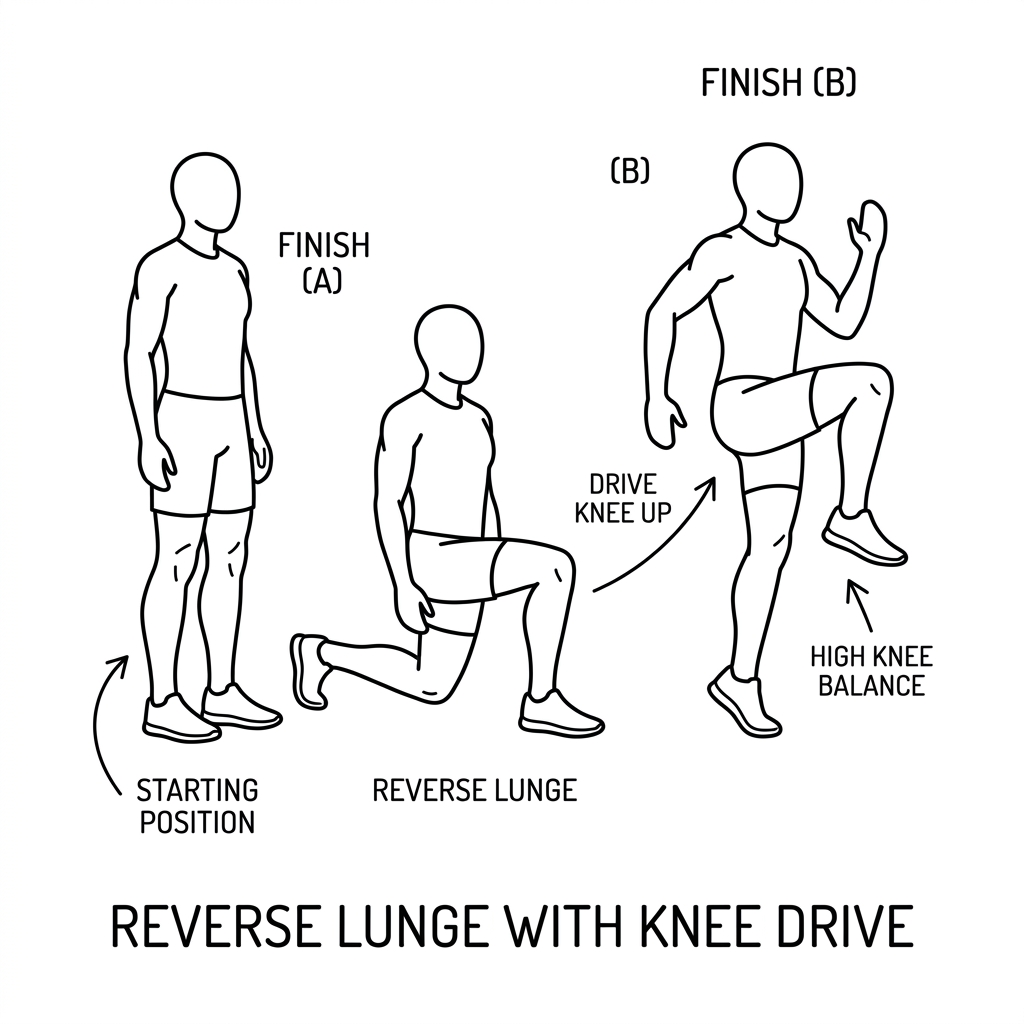
6. Reverse Lunge into Knee Drive

Focus: Concentric Drive & Acceleration Sets: 3-4 Reps: 4-6 per leg Material: Field
Reverse Lunge & Drive Exercise

This combines a deep reverse lunge immediately exploding into a forward, high knee drive. It heavily mimics the mechanics of accelerating out of a cut or sprinting, making it highly specific for football performance.

  • Drop into a deep, controlled reverse lunge.
  • Explode upwards and forwards forcefully off the front leg.
  • Drive the back knee up rapidly towards the chest.
  • Maintain a strong, upright posture throughout.